BurpeeTalk Original
**The last ten seconds: why even the fittest athletes don't always give everything**

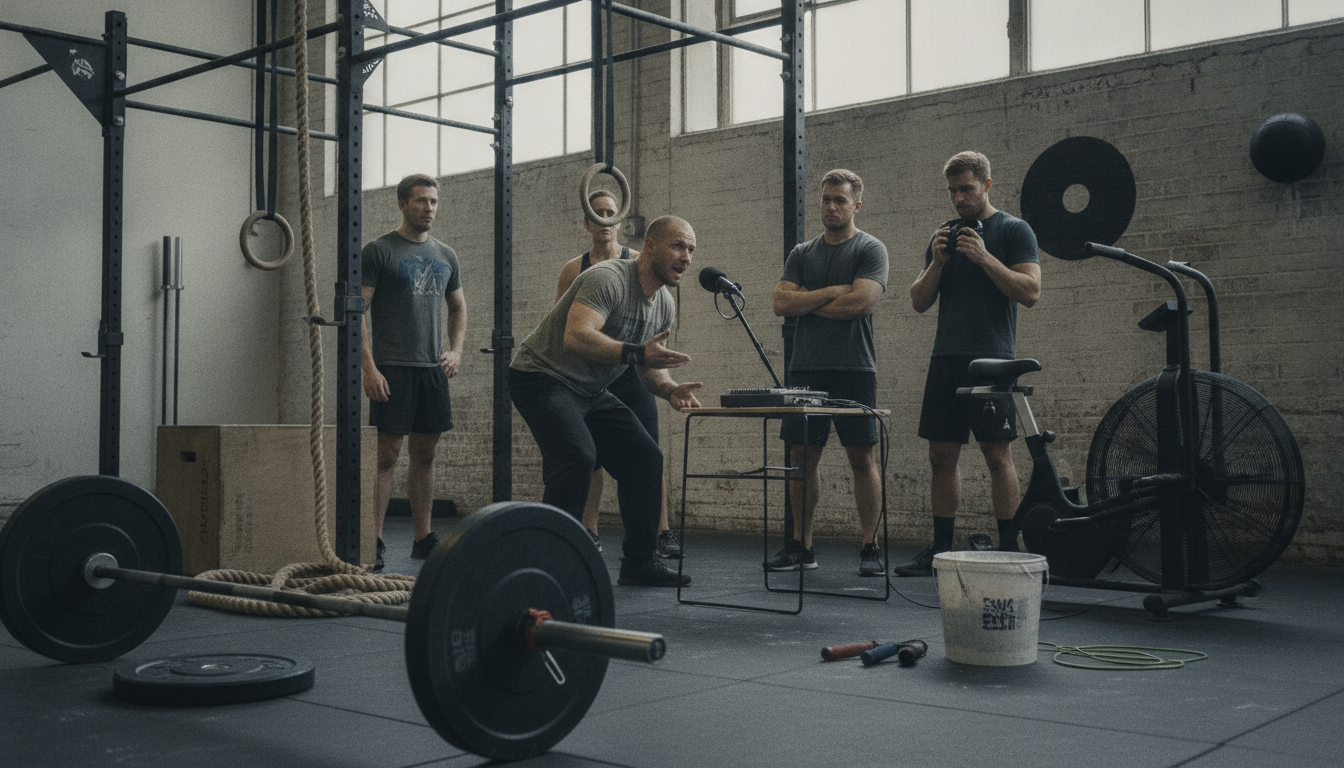
Can you truly perform at one hundred percent during a training session? Or does competition bring out something in an athlete that simply cannot be found in the gym? In a conversation between CrossFit athletes Dallin Pepper and Justin, a discussion unfolds about the boundary between mental strength, performance pressure and exhaustion.
Imagine you are on the rowing machine, the finish line is approaching and a competitor is right beside you. You have a ten-second lead. Thirty calories to go. You know that if you ease up now, the other person can catch you.
What do you do?
For Dallin Pepper, one of the most prominent names in the CrossFit world, this is precisely the kind of moment where competition makes the difference. The physical effort may be no different from a training session, but the circumstances change everything. Something is at stake. There is an opponent. There is an audience. And sometimes there is a significant sum of money to be won.
Pepper believes that in a competition an athlete can tap into something that is harder to access during a regular training session. Not because he does not work hard enough in the gym, but because competition adds an extra stimulus.
Justin does not entirely agree. According to him, it is possible to summon that mental state during training as well. An athlete can imagine standing on the CrossFit Games podium, a competitor alongside, with no second to spare. The circumstances may not be real, but the focus and intensity can be.
It sounds like a discussion about a few percentage points of extra effort. In reality it concerns a much larger question: how much of a peak performance is determined by physical capacity, and how much by the circumstances in which that capacity is called upon?
The difference between 99 and 100 percent
In the conversation, Pepper describes the difference between training and competition as the difference between 99 and 100 percent. He uses the example of an athlete defending a small lead on the rowing machine during a competition. The knowledge that a competitor is closing in can enable the athlete to find one extra gear.
That is not necessarily a conscious decision. In a competition, the situation itself can sharpen motivation. You do not have to imagine someone overtaking you: you watch it happen.
Pepper therefore wonders whether an athlete can truly recreate the same conditions during training. You can perform a workout that was used at the CrossFit Games. You can set the same time limit, use the same weights and try to reach the same intensity. But the awareness that no official result is on the line remains.
Justin sees a mental skill in precisely that. He describes how during a training session he can visualise a competitor standing beside him. When performing a heavy combination of thrusters and the Echo Bike, for instance, he can picture himself having to make up a deficit. Even during the conversation he notices that the idea motivates him all over again.
According to him, the competitive situation therefore does not have to be literally present in order to trigger a comparable mental response.
The difference between the two positions is subtle but meaningful. Pepper argues that competition adds something that cannot be fully replicated. Justin contends that an athlete can learn to summon the same mental intensity, even when the circumstances are not real.
Both acknowledge that competitive sport has a different dynamic from a training session. The key question is whether that dynamic actually enables an athlete to perform more, or simply helps the athlete make better use of what is already there.
What happens under pressure?
Sports psychology has several terms for the way athletes respond to pressure. Two of them are clutch performance and choking under pressure.
In clutch performance, an athlete manages to reach a performance goal under heightened pressure. Attention remains focused on the task and the athlete retains sufficient control over their actions. With choking, the opposite occurs: the pressure leads to a clear deterioration in performance.
That distinction matters. Competition nerves are not an automatic performance enhancer. The presence of an audience, money or a competitor can provide extra motivation, but can also lead to doubt, distraction or a loss of control.
A 2024 meta-study, in which researchers brought together 29 qualitative studies on performing under pressure, points to factors such as self-confidence, mental resilience and the ability to keep attention on the task. Preparation techniques such as visualisation, self-talk and practising competition scenarios can also help.
That supports part of Justin's argument: the mental side of performance is trainable. But it does not prove that an athlete can deliver exactly the same performance in a training environment as on the competition stage.
Researchers also draw a distinction between the pressure an athlete experiences and the way they respond to it. Two athletes can find themselves in identical competition conditions and handle them very differently.
One uses the tension as motivation. The other loses focus entirely.
Simulating competition
The idea of deliberately incorporating competitive pressure into training is known in sports psychology as pressure training.
The principle is that athletes are exposed in a controlled way during training to conditions that resemble the pressure of competition. This can be achieved, for example, by giving an exercise a clear consequence, adding a competitive element or limiting the number of attempts.
A study published in 2023 in the Journal of Applied Sport Psychology examined how sports psychologists and athletes think about creating pressure during training. The conclusion was that such exercises can help athletes become familiar with competition conditions and manage tension more effectively.
That does not mean every training session should be made as demanding or competitive as possible. The pressure must match the goal of the session and be built up carefully. Otherwise the remedy can overshoot its purpose.
And it is precisely there that the discussion touches on a second point raised in the conversation.
The cost of always performing at maximum
Justin acknowledges that in an earlier phase of his career he frequently trained at maximum intensity. He believes that approach contributed to his early successes. But he also says that it ultimately left him mentally exhausted.
He describes how his training for a long time revolved almost entirely around maximum intensity, with little room for any other approach. That proved difficult to sustain in the long run.
His experience makes the discussion more interesting. If it is possible to summon the same mental intensity during training as during competition, should you do so as often as possible?
The answer is probably no.
A training session is not a collection of individual competitions. It is part of a larger process in which load, recovery, technique and conditioning must all connect. An athlete who treats every session as though a title is on the line risks losing the bigger picture.
The podcast also touches on interval training. Justin explains that he regularly includes intervals in his training schedule. As a competition approaches, the emphasis shifts, he says: it becomes less about building general fitness and more about learning to execute workouts, including pacing and tempo management.
That is an important distinction. An athlete must learn not only how hard they can go, but also how to distribute their effort. Someone who gives everything from the first minute may have little left for the decisive phase of a competition.
The best performance does not therefore necessarily come from the hardest training. Sometimes the real skill lies in not trying to prove everything every day.
What is really at stake?
Pepper brings the discussion back to the competition itself. What if 300,000 dollars is on the line? What if you are standing under stadium lights, the crowd is calling your name and you know the result could define your career?
In that moment, he believes, something happens that you cannot fully reproduce in a training room.
Justin maintains that an athlete can also place themselves mentally in that situation. He does not deny that competition is a different experience, but he believes the required focus and intensity can be summoned during training as well.
Perhaps the two positions are less contradictory than they appear. Pepper is talking primarily about the extra stimulus that a real competition provides. Justin is talking about the ability to prepare yourself mentally and deliver a comparable effort.
One does not exclude the other. An athlete can give everything that is possible in a given training session, while the conditions of a competition still produce a different performance.
And perhaps that is the heart of the debate: one hundred percent is not a fixed number that can be reached in the same way every day. It depends on the athlete's physical condition, their mental preparation and the circumstances in which they must perform.
Not every training session needs to be a final
To outsiders, CrossFit can seem like a sport in which everything revolves around harder, faster and heavier. The discussion between Pepper and Justin reveals a different side. Even at the highest level, athletes are grappling with the question of how to understand and push their own limits.
Pepper believes competition can unlock an extra gear. Justin thinks that gear can also be found through your own efforts. His own experience also shows that training constantly at maximum intensity can carry a mental cost.
The most interesting conclusion is therefore not that one athlete is right and the other wrong. It is that peak performance demands more than physical fitness or willpower alone.
An athlete must know how to place themselves under pressure, but also when to release that pressure. They must learn to give everything when the moment calls for it, without turning every training day into a decisive competition.
Perhaps the best athlete is not the one who tries to give one hundred percent every day.
Perhaps it is the one who knows exactly when one hundred percent is needed.