News
Rachel Noel: Roadmap to the World's Best
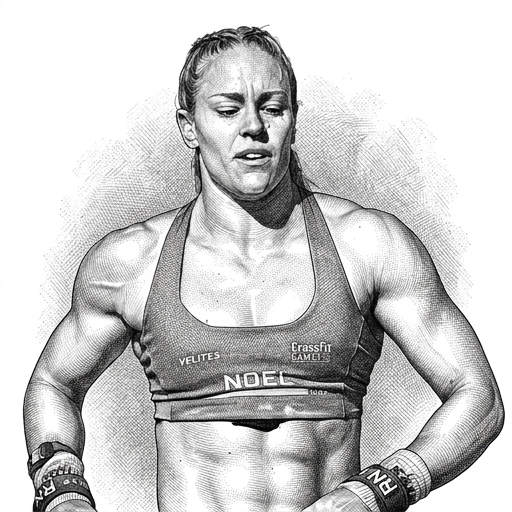
For many athletes, competing at the CrossFit Games is the ultimate destination. For Rachel Noel, it looks more like the beginning of a new phase. After her debut on the sport's biggest stage, the American did not return home with questions about her future, but with a remarkably clear picture of what it will take to reach the next level.
That may be the greatest takeaway from her first Games appearance.
Noel was not among the favorites for a top finish. She arrived as a newcomer surrounded by experienced Games athletes and knew the weekend would mainly reveal where her current ceiling sits. That realistic mindset proved to be an advantage. Where some athletes crumble under the pressure of their first Games, Noel seemed to thrive on the absence of expectations.
Notably, she felt more nerves at the NorCal Classic, where a Games qualification spot was on the line, than at the Games themselves. Once she had qualified, the season's biggest goal already felt accomplished. That gave her room to learn, to observe and, above all, to discover where the real gaps between her and the world's best actually lie.
Games-level demands more than fitness
The most important conclusion Noel drew is that pure fitness is no longer enough at the Games level.
In recent years the sport has evolved into a discipline where technical skills increasingly make the difference. Triple unders, pegboards, roll-to-supports, freestanding handstand push-ups and other complex gymnastic movements are no longer surprises. They are now part of the modern profile of a complete CrossFit athlete.
For Noel, that reality was already becoming clear during the season. The priority was initially on qualifying for the Games, which meant certain skills received less attention, simply because they were unlikely to play a decisive role during the qualifying phase.
Only after securing a Games spot did space open up to train those elements more deliberately.
That says something about the current state of the sport. More and more athletes appear to be running two seasons in effect: first a campaign to qualify, then a fresh preparation to become truly competitive at the Games.
The frustration of the bike
Nowhere was that gap more apparent than during the grass bike race.
Noel is considered a strong cyclist on stationary machines, which is exactly why the result stung. Not because her fitness fell short, but because she came face to face with a technical element that rarely receives meaningful attention in standard CrossFit training.
Looking back, she did not see it as a physical problem. Her engine was running well, her legs felt strong and her endurance was there. The difference came down to skill: managing gears, maintaining speed on grass and transferring power efficiently on a bike that creates constant resistance.
For many CrossFit followers, that may be the most interesting observation from her Games weekend. Not every mediocre result calls for more training hours or more conditioning work. Sometimes a poor performance simply calls for learning a new skill.
The engine is there
That does not mean Noel came away empty-handed.
Far from it.
In several endurance- and conditioning-focused events she showed why coaches and insiders rate her potential so highly. A fifth-place finish in a machine event combining rowing and skiing, a strong performance in the 500-metre sprint and solid results in longer efforts all confirmed that her aerobic base is among her greatest weapons.
That is precisely why her development path looks relatively clear. The engine does not need to be rebuilt from scratch. The biggest gains lie in strengthening weaker links.
More pressing strength. More gymnastic capacity. More technical mastery.
Those are areas that take time to improve, but they are also concrete and trainable.
Not an endpoint, but a beginning
Perhaps that is what makes Rachel Noel so compelling heading into the seasons ahead.
Many first-timers leave the Games feeling like they simply survived. Noel seems to have mostly discovered what is possible. She knows where the gaps are, understands why they exist and has a coaching structure that appears focused on long-term development.
The question is therefore not so much whether her first Games was a success.
The real question is how much progress an athlete can make when her first visit to the CrossFit Games is not seen as a high point, but as a roadmap to the next destination.