News
The architecture behind Wodapalooza SoCal
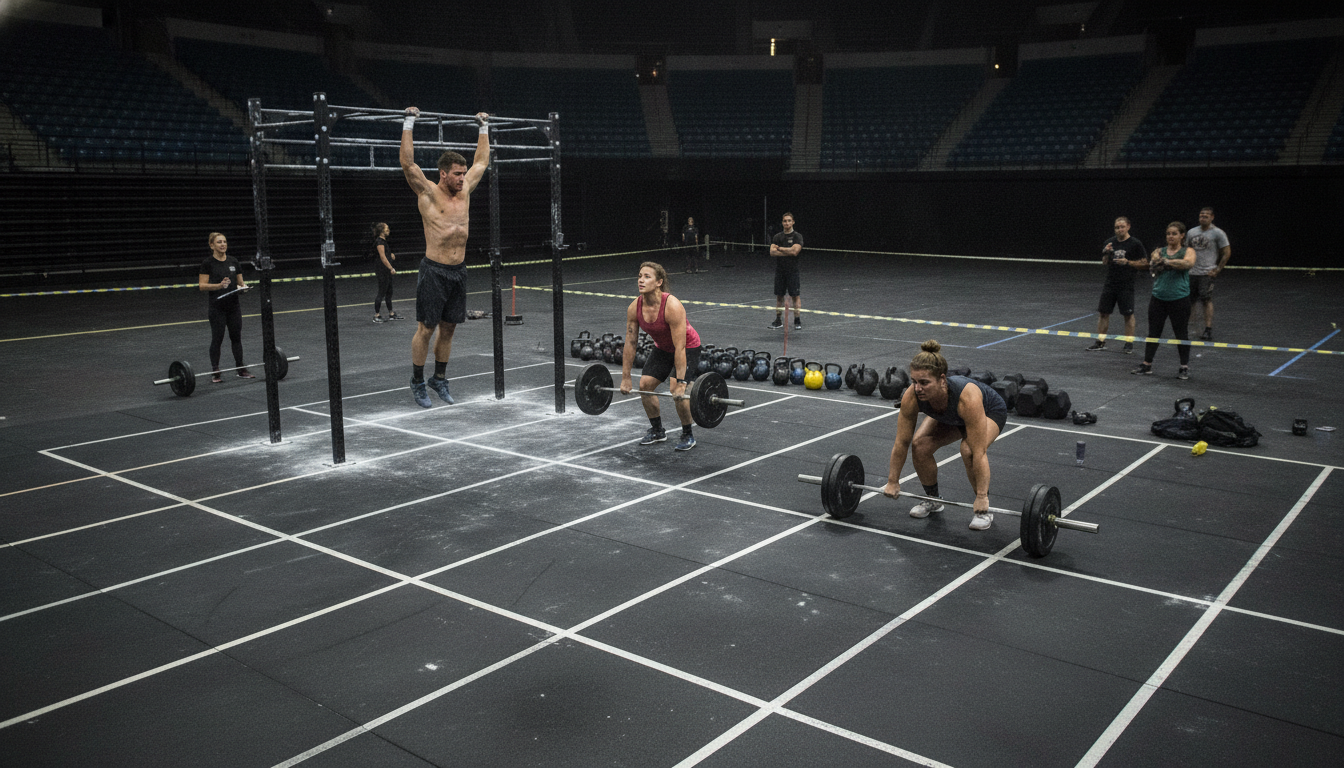
The best competition programming is not about inventing new movements. It is about asking the right questions. After conversations with people involved in Wodapalooza SoCal and additional research into the released workouts, one thing stands out above all: this competition appears to have been deliberately designed to force teams into uncomfortable choices at every turn.
At a time when many elite competitions are starting to look increasingly alike, Wodapalooza SoCal takes a different route. The programmers did not try to reinvent the wheel. Instead, they took classic CrossFit tests and amplified the strategic consequences.
The weakest link front and center
That starts with the opening event, which combines triple unders, a handstand hold from an L-sit and a Curtis P complex.
On paper, they look like three separate skills. In reality, they are linked. Performance in one element determines the conditions for the next. Teams are therefore forced to look beyond individual qualities.
The same principle reappears multiple times throughout the weekend. Not just who is best at something, but how a team deploys its specialists, seems set to be the decisive factor in the standings.
That is a notable choice in a sport that has increasingly evolved toward individual peak performance in recent years.
Familiar workouts, new problems
Take Shoulder Season.
The workout consists of chest-to-bar pull-ups, rowing and overhead squats. For experienced CrossFit athletes, those are hardly surprising movements. Yet the difficulty here lies not in the individual elements but in the fatigue that accumulates in the shoulders, grip and forearms.
That pattern recurs throughout.
The version of Diane on the programme combines deficit strict handstand push-ups, deadlifts and the Echo Bike, with certain rounds performed in reverse order. A small adjustment, but enough to disrupt an athlete's rhythm and redistribute recovery windows.
Good programming does not create chaos. It creates dilemmas. That appears to have been exactly the starting point.
Teamwork as a performance indicator
The most interesting development within SoCal may be the emphasis on collaboration.
Workouts like High Ballers and Two Minutes of Fame are not events where one superstar can carry a team single-handedly. They demand timing, communication and efficiency.
High Ballers in particular stands out, combining synchronized wall balls with progressively higher box jump-overs. The rising box heights turn a relatively simple movement into a potentially decisive element. It is a rare example of a workout in which the box jump-over is not merely a transition movement but may well be the difference between winning and losing.
Two Minutes of Fame presents a different problem. Teams must constantly weigh how much risk to take during work intervals on the worm. Opening too aggressively can be punished later. Starting too conservatively can mean a competitor has already disappeared out of sight.
That kind of question is what makes competitions interesting, not only for participants but for spectators too.
The return of old-fashioned suffering
Yet classic suffering is not absent.
Among the most talked-about events is a heavy team test involving ski ergs, burpees, goblet squats, GHD sit-ups and goblet step-overs. There is little technical complexity in it. That is precisely why it is so effective.
Where modern CrossFit programming sometimes gets caught up in refinement and nuance, this workout serves as a reminder that the sport ultimately still comes down to getting work done while fatigue piles up.
Every major competition needs an event that does not call for perfect strategy but for pure resilience.
This looks set to be that event.
A competition with character
After analysing the released workouts, a clear picture emerges of what Wodapalooza SoCal wants to be.
Not a collection of standalone events, but a coherent test in which each workout tries to expose a different weakness. Some events reward technical precision. Others reward communication. Others simply test how deep an athlete is willing to go when every system is fatigued.
That is ultimately the strength of this programming. The movements are familiar. The circumstances are not.
And that is precisely where competitions are decided.