BurpeeTalk Original
Not Their Body, But Their Performance
There are moments when a sport dares to look at itself in the mirror. Not to celebrate records or count revenue, but to ask an uncomfortable question: what do we actually see when we look at female athletes?
With the publication of Raising the Bar, the European Broadcasting Union (EBU) has done exactly that. The document, drafted in collaboration with elite Olympic athletes such as Holly Bradshaw, Ivana Španović and Blanka Vlašić, is a remarkable acknowledgment that the way sport is filmed is not neutral. Cameras tell stories. The question is which story they tell. [EBU_Sport_...ng_the_bar | PDF]
The core message of the report is simple: point the camera at performance, technique and emotion, not at body parts. Avoid low camera angles, unnecessary slow motion and zoomed-in shots that add little to the viewer's understanding of the sport but do contribute to the sexualization of female athletes. [EBU_Sport_...ng_the_bar | PDF]
That sounds obvious.
And yet it feels revolutionary.
The Translation to CrossFit
Because if there is one sport where this discussion belongs, it is CrossFit.
CrossFit likes to present itself as the most meritocratic sport in the world. Weight on the bar does not lie. The clock has no preference. A woman who clean-and-jerks 140 kilograms or completes 100 chest-to-bar pull-ups deserves respect in exactly the same way as a man.
But watch the broadcasts of the CrossFit Games, semifinals or major events, and an uncomfortable tension sometimes emerges between that ideal and reality.
CrossFit athletes wear functional sportswear. That is a necessity. You cannot perform heavy snatches, handstand walks or rope climbs in an eighties tracksuit. But that is precisely why camera choices matter.
When a camera sits low behind a female athlete during wall balls.
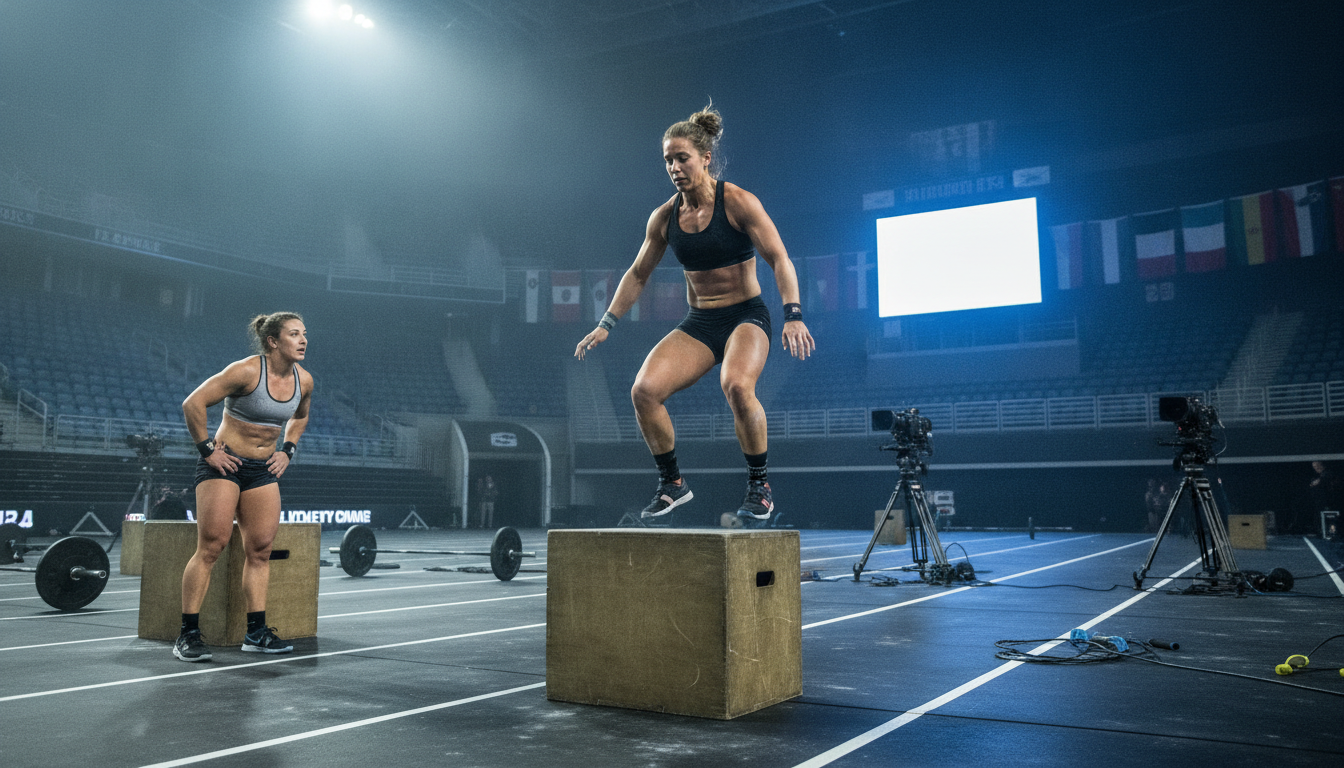
When slow motion is replayed endlessly during box jumps.
When close-ups of fatigue and body positioning receive more airtime than the technical execution of a lift.
The focus shifts, almost imperceptibly, from what someone does to what someone looks like.
That is exactly the problem the EBU describes for athletics. [EBU_Sport_...ng_the_bar | PDF]
The Purist Argument
Critics will say that CrossFit is different.
CrossFit is, after all, about the body. About muscular strength. About physical capacity.
That is true.
But athletics is also about the body. A pole vaulter, long jumper or hurdler cannot exist without exceptional physical attributes. Yet the EBU concludes that there is a fundamental difference between showing athletic performance and exploiting footage that draws attention primarily because of its sexual connotation. [EBU_Sport_...ng_the_bar | PDF]
That lesson applies directly to CrossFit.
In fact, it may be even more relevant there.
What Are We Actually Missing?
The irony is that better camera work would not only be more respectful.
It would also be more interesting.
The EBU repeatedly points out that the most informative camera angles are often the same as the most dignified ones. Cameras that show the approach, technique, timing and movement provide more insight for viewers and commentators. [EBU_Sport_...ng_the_bar | PDF]
Translate that to CrossFit.
Why do we not see more often:
- foot placement during a heavy split jerk?
- hip extension in a snatch?
- transition efficiency between movements?
- pacing strategy during a chipper?
- biomechanical analysis of rowing or ski-erg?
The sport has a wealth of technical complexity. Yet the production sometimes opts for dramatic close-ups that work emotionally but explain very little.
CrossFit wants to be taken seriously as elite sport.
Then its broadcasts must also conduct themselves as elite sports journalism.
What Does This Mean for Female Athletes?
For female CrossFit athletes, such an approach would mean more than just "cleaner" images.
It would mean a shift in the way success is defined.
No longer:
"Look how fit she looks."
But:
"Look how brilliantly she executes her race."
That difference seems small.
It is enormous.
Athletes like Tia-Clair Toomey, Laura Horvath, Emma Lawson and Arielle Loewen did not reach their position because of their appearance. They are among the most versatile athletes in the world. Their story lies in training volume, tactics, technique, recovery and mental resilience.
That is what the camera should be talking about.
Should CrossFit Do the Same?
My answer is unambiguous: yes.
Not because CrossFit has a bigger problem than other sports.
But because CrossFit has an opportunity to be better.
The EBU guidelines are not censorship. They do not ban footage. They simply ask directors to ask themselves one question:
"Does this shot help the viewer understand the sport better?" [EBU_Sport_...ng_the_bar | PDF]
If the answer is no, why use it?
That is a question every CrossFit organization, from the local competition to the CrossFit Games, should ask itself.
Because ultimately, fans do not watch female CrossFit athletes because they are women.
They watch because they are extraordinary athletes.
And when the camera starts from that same premise, everyone wins. Perhaps most of all, the sport itself.